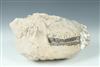
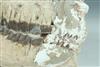
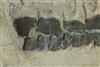
OREODONT FOSSIL IN MATRIX. 'Merycoidodontoidea, referred to as oreodonts, or ruminating hogs is an extinct superfamily of prehistoric cud-chewing artiodactyls with short faces and fang-like canine teeth. As their name implies, some of the better known forms were generally hog-like, and the group was once thought to be a member of Suina, the pigs, peccaries and their ancestors, though recent work indicates they were more closely related to camels. "Oreodont" means "mountain teeth", referring to the appearance of the molars. Most oreodonts were sheep-sized, though some genera grew to the size of cattle. They were heavy-bodied, with short four-toed hooves and comparatively long tails. This diverse group of stocky prehistoric mammals grazed amid the grasslands, prairies, or savannas of North and Central America throughout much of the Cenozoic era. First appearing 48 million years ago during the warm Eocene epoch of the Paleogene period, the oreodonts dominated the American landscape during the dry Oligocene epoch, but they mysteriously disappeared during the colder Pliocene epoch of the late Neogene period.'
Today, fossil jaws and teeth of the Oreodonta are commonly found amid the 'Oreodon beds' (White River fauna) of the White River badlands in South Dakota, Nebraska, and Wyoming. Many oreodont bones have also been reported at the John Day Fossil Beds National Monument in Oregon. Some oreodonts have been found at Agate Fossil Beds National Monument.' - 7 1/8" high x 13" long x 6" deep. Estimate $150-250