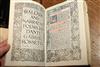
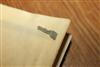
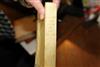
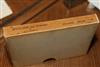
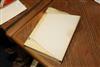
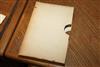
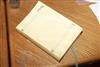
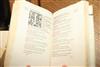
A SUPERB KELMSCOTT PRESS BOOK,Rossetti, Dante Gabriel. BALLADS AND NARRATIVE POEMS. Printed by William Morris at the Kelmscott Press, Hammersmith; published by Ellis & Elvey, 1893. Original binding: limp vellum with author and title lettered in gilt, extended edges of the covers -- with silk ties at the fore-edges. A beautifully preserved copy. The original ties attached to the front cover have broken, but the rear ties remain at full length. (This is not unusual for Kelmscott books, many of which have lost all traces of their fragile original silk ties). Preserved in a plain folder/box made of card stock. This improvised box has done a splendid job of keeping the original fresh. This is one of 310 ten copies printed on paper -- (there were also six copies on vellum). William Morris established the Kelmscott Press at Hammersmith in January 1891. Between then and 1898, the press produced 53 books -- which have been avidly sought since they were printed, and have exerted an influence on the world of design and book-making which is impossible to overstate. This early volume from the press is very much a production of William Morris, himself. It was printed in his Kelmscott Golden type -- richly inked in black and quite a lot of red. The characteristic woodcut Kelmscott grapevine borders surround both the title page and the first page of text. Morris also designed the floriate initial letters used throught the volume. Ransom #20.
PROVENANCE: Estate of Jim Graham, former Washington, DC, Councilman Estimate $1,500-3,000
NOTE: Herbert Boyce Satcher was born in Trenton, South Carolina, July 24, 1890. He was admitted to the Philadelphia Episcopal Divinity School in the autumn of 1914, and graduated, June, 1917. One year before Satcher's graduation, the Trenton 'Evening News' reported his ordination as a minister by Bishop Matthews of New Jersey. Satcher was drafted into the U. S. Army at Keyport, New Jersey on June 5, 1917. His induction papers recorded his occupation as Clergyman, empolyed by the Episcopal Diocese of New Jersey, at Carteret. After the end of the war, Satcher is recorded as having met the French collector and manuscript forger who called himself Dorian Hope, suggesting that Satcher was already seriously in pursuit of material related to Oscar Wilde.
As recorded in the U. S. Census in 1920, Satcher, age 29, was single, lodging at Lombard Street, in Philadelphia. Ten years later in the next census, Herbert Satcher's address had changed to 118 Old Soldiers Road, Cheltenham, Montgomery County, Pennsylvania. He was stated to continue to be a clergyman in the employ of the Episcopal Church.
The next decennial Census records the same information for the 39 year old Satcher, adding that his official salary was $1800 per year. His next appearance in the records of officialdom is to report that Satcher, now 51, was again drafted in the U. S. Army at Philadelphia, on April 27, 1942. This draft record states his place of employment: St Aidan's Chapel, Central Avenue & Cottman Street, Cheltenham. This is a township in the northern suburbs of Philadelphia.
Records show that Satcher served as a vicar at St. Aidan's Chapel from 1924-1958 - becoming an authority of church music. Before he died in 1966, he spent decades as an avid book collector, with interests in both secular and sacred material. Chief among his secular collection's focus was the works of the Uranian poets and male homosexuality. A portion of Satcher's secular library commingled with that of his close friend Dr. Nöel J. Cortes, the Philadelphia book collector, painter and physician. Highspots of his theological collections formed a substantial bequest to the special collections of the National Cathedral in Washington, DC -- (now largely deaccessioned and disbursed). Many volumes from Satcher's thousands of secular books were sold at auction at Freeman's, in Philadelphia - about twenty years ago.