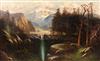
ALBERT BIERSTADT (American, 1830-1902). MT. ROSALIE AND THE CHICAGO LAKES, COLORADO, monogrammed indistinctly lower center. Oil on canvas - Framed, 30 in. x 48 in. Estimate $150,000-250,000
The information set forth below provides results and an analysis from a recent scholarly study of Bierstadt's MT. ROSALIE AND THE CHICAGO LAKES, COLORADO. Supplementary material from cited References no. 1 through 9, is available in the Sloans & Kenyon file
AGE An examination indicates that the canvas was originally attached directly to the stretcher board. The stretcher board itself likely dates to within a few years of the age of the canvas and the painting. The original tacks used to fasten the canvas to the board are still in the board, and two of them have remnants of the canvas underneath. A small sample of the wood from the stretcher board was radiocarbon dated by DirectAMS, Botnell, Washington (Ref. 1). While this technique is not precise, results suggest a high probability that the wood used to make the stretcher board was cut between about 1866 and 1919, but possibly as early as 1855.The inscription "Chicago" in graphite on the top stretcher board, reverse side, links the painting itself to the scene, as "Chicago" is the name of the lakes, even today, in the painting. The lakes are easily found on Google Earth, from an overhead vantage point. Both STORM IN THE ROCKY MOUNTAINS, painted by Bierstadt and now at the Brooklyn Museum of Art, and an 1873 photograph of the site (Ref. 2) found on-line establish this as the same site. Further, "Chicago", as well as the letters "B" and "P", on the backing for the canvas appear to be in Bierstadt's hand (Ref.3). Particularly, the "B" is very similar to one used on a photo portrait of Bierstadt (Ref. 4). The letters "BP" may represent "back of painting," put there so that whoever fastened (likely glued with sap or other adhesive) the canvas to the backing, did it on the coarse (rather than smooth) side of the backing for better adherence, which is what was done. If these letters were written by Bierstadt, that indicates that the transfer of the painting from stretcher boards to the backing (attached to the original boards) was done while Bierstadt was still living, sometime before 1902. The type of paperboard backing was used as a backing by Bierstadt as early as 1859 for SURVEYOR'S WAGON IN THE ROCKIES (oil on paper on Masonite, Ref. 5), now at the St. Louis Museum of Art.
LOCATION The painting is of Mount Rosalie (in 1895 renamed as Mount Evans after a former Governor of Colorado), which Bierstadt visited in 1863, on his second trip to the West, and he made studies of it. A comparison of slope angles from a photograph of the site with slopes in the subject painting shows very good correlation (Ref. 6). The painting STORM IN THE ROCKY MOUNTAINS, depicts the same site, only from a vantage point a little farther from the peaks. That work is dated 1866, well after Bierstadt returned to New York from the 1863 trip. Therefore, this study appears to date from between 1863 and 1866, and is very likely one of the studies for STORM IN THE ROCKY MOUNTAINS.
SIGNATURE According to the Archives of American Art Online Art Inventories Catalog, Bierstadt made 67 studies that have survived, 23 of which are signed, and one of those was signed "AB" (Ref. 7, landscape, titled MOUNTAIN STUDY.) The initials "AB" in the subject painting are found along the bottom center. There are many more finished works signed "AB", and many more studies are cited by Gordon Hendricks, a Bierstadt biographer, at different locations where Bierstadt painted. According to Hendricks, Bierstadt on his second trip west "garnered enough inspiration and studies to last for years." According to William Newton Byers (Ref. 8), a guide and eyewitness at Mt. Rosalie, and Hendricks "... [at Mount Rosalie, Bierstadt] made studies for A STORM IN THE ROCKY MOUNTAINS. More studies likely would have survived if there had not been a major fire at Bierstadt's house in Irvington, NY, in 1876. However, Bierstadt kept much of his work at his 10th Street studio in New York City. One visitor to that studio noted how many of Bierstadt's works were carefully organized by location in portfolios (Hendricks, p. 240).
A review of Bierstadt paintings auctioned since 1995 (Ref. 9) reveals twenty in which the artist signed with conjoined initials, or a monogram, sometimes obscuring them or blending them into the background. Therefore, the difficulty in discerning the monogram in the subject painting is not surprising.
SIMILARITY OF WORKS Interestingly, in 1870 Bierstadt painted THE EMERALD POOL, a scene in the White Mountains of New Hampshire, reminiscent of the subject painting because the pool in the subject painting (Chicago Lake) reveals a distinct green tinge. Similarly, another specific finished work, titled CALIFORNIA REDWOOD, was based on a study made by Bierstadt on the same 1863 trip west. CALIFORNIA REDWOOD was completed in 1875.
BIERSTADT'S ART PRACTICE According to a Santa Barbara Museum of Art Exhibition Catalog (1964), "[Bierstadt].... sketched incessantly, storing up ideas for finished canvases," and "Bierstadt did not hesitate to distort or even invent natural features for the sake of adding impressive grandeur to his paintings." That seems to be the case in the subject painting because the "sawtooth" peaks that Byers, Bierstadt's companion, referred to (Ref. 8, Magazine of Western History,1890) appear to be at a higher elevation than those in the 1873 photograph (Ref. 2).
Regarding the subject painting, it's likely that Bierstadt made oil and pencil sketches at the site of Mount Rosalie, later improving them as studies in oil (the subject painting) when he returned to New York, and later completed the finished piece, which would be STORM IN THE ROCKY MOUNTAINS. Because STORM IN THE ROCKY MOUNTAINS is much larger than the subject painting and is dated 1866, that date leads to the conclusion that with the subject painting was a study for the larger work. The Brooklyn Museum, in its online description, states that "In 1863 Bierstadt made on-site studies for the work, which he completed in his New York studio." =========================================== REFERENCE BACKGROUND
Gordon Hendricks, Albert Bierstadt, Painter of the American West, 1988, published by Harrison House/Harry N. Abrams, New York, NY, in conjunction with the Amon Carter Museum of Western Art, Dallas, TX
Santa Barbara Museum of Art, Albert Bierstadt, 1830-1902, Retrospective Exhibition, August 5 - September 13, 1964, Exhibition Catalog.
A Storm in the Rocky Mountains, Mt. Rosalie, Wikipedia
Magazine of Western History, January 1890, Bierstadt's Trip to Colorado and Chicago Lakes, by William Newton Byer, available on-line.
Albert Bierstadt, Wikipedia
Mount Evans, Wikipedia
Archives of American Art " Art Inventories Catalog. " Letter to Mrs. P. Parsons, Jan. 21, 1861 .
DirectAMS, Radiocarbon Dating Service, Botnell, WA, Nov. 2018.