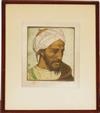
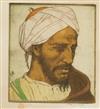
TAVIK FRANTISEK SIMON (Czech, 1877-1942). Arab in Rose Turban, circa 1920, Woodcut with colors. Pencil signed at base. Framed. Not examined out of frame. - Size (approx): Sight: 9 X 8 inches; frame: 16 x 14 inches Estimate $200-250
PROVENANCE: Acquired at Sloans, 9 July 1993; lot 2250
ARTIST PROFILE: Tavik Frantisek Simon was a Czech painter, etcher, and woodcut artist. Largely ignored during the Communist era in Czechoslovakia, his work has received greater attention in recent years. As a student at the Academy of Fine Arts, Prague, he received a stipend that allowed him to travel to Italy, Belgium, England and France. He had his first solo exhibition in Prague in 1905, and a Paris exhibition in 1906. His extensive travels would eventually also bring him to New York City, London, the Netherlands, Spain, Morocco, Ceylon (now Sri Lanka), India, and Japan, images of all of which appear in his work. After spending 1904-1914 based in Paris, Šimon returned to Prague and became a professor at the Academy of Fine Arts in 1928. In 1917, he became a founding member of the Hollar Association of Czech Graphic Artists, which he later chaired. Many of his most notable images are of Prague, Amsterdam, New York, and Paris, but also include portraiture and self-portraiture and images of the Czech and Slovak countryside. Šimon's style was strongly influenced by the French Impressionists and, perhaps through them, by Japanese printmaking techniques, in particular color aquatints with soft ground etching. Šimon was also a master of the mezzotint but completed very few prints in this difficult medium, most of them being female nudes in subtle tones of black.