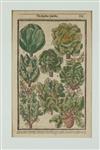
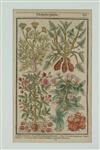
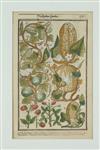
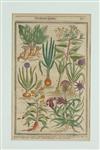
COLLECTION OF FOUR 17TH CENTURY GARDEN WOODCUT PRINTS FROM JOHN PARKINSONS' PARADISI IN SOLE PARADISUS TERRESTRIS.1656 Edition. Printed London, by Humfrey Lownes and Robert Young. Four matted, of the period plates from the the most famous gardening works of the 17th Century, Park-in-Sun's Terrestrial Paradise, the 1656 edition. Consisting of Page 505, Brassica capitata: Close Cabbage, (#49333.1), Page 517, Carum, Carawayes. Battatas Hispanorum, Spanish Potatoes (#49334.1), Page 511, Raphanus Rusticanus, Horse Raddish (#49336.1), Page 527, Lepodium (ive piperita)and Cucumis hispanicus, Spanish Cowcumber (#49337.1) All measuring 12 1/2" high x 8 1/4" wide to 12 7/8" high x 8 1/4" wide.
'John Parkinson was the last of the great English herbalists. He was apothecary to James I and a founding member of the Worshipful Society of Apothecaries in December 1617, and was later Royal Botanist to Charles I. He is known for two monumental works, Paradisi in Sole Paradisus Terrestris (Park-in-Sun's Terrestrial Paradise, 1629), which generally describes the proper cultivation of plants; and Theatrum Botanicum (The Botanical Theatre or Theatre of Plants, 1640), the most complete and beautifully presented English treatise on plants of its time. One of the most eminent gardeners of his day, he kept a botanical garden at Long Acre in Covent Garden, today close to Trafalgar Square, and maintained close relations with other important English and Continental botanists, herbalists and plantsmen.' Parkinson actively sought new varieties of plants through his contacts abroad and by financing William Boel's plant-hunting expedition to Iberia and North Africa in 1607–1608. He introduced seven new plants into England and was the first gardener in England to grow the great double yellow Spanish daffodil. His piety as a Roman Catholic is evident from Paradisi in Sole. In his introduction, Parkinson saw the botanical world as an expression of divine creation, and believed that through gardens man could recapture something of Eden. Paradisi in Sole Paradisus Terrestris describes the proper cultivation of plants in general, and is in three sections: the flower garden, the kitchen garden, and the orchard garden. It does not include specific growing instructions for each type of plant, but at the start of each main section Parkinson provides instructions on "ordering" each type of garden, advising on situating and laying out a garden, tools, soil improvement, grafting, planting and sowing and the types of plants that should be included in each type of garden. It contains illustrations of almost 800 plants in 108 full-page plates. Most of these were original woodcuts made by the German artist Christopher Switzer, but others appear to have been copied from the works of Matthias de Lobel, Charles de l'Écluse and the Hortus Floridus of Crispijn van de Passe the Elder.' Estimate $300-400
From the Collection of The Old Print Gallery, Washington, DC.
Toning to all and a rough left edge of sheet to all associated with being bound. Plate 511 having an 4 1/2" area of loss to edge, not extending into the image, and several creases which extend into image. All plates have text to verso and good color.