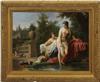
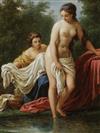
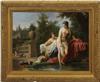
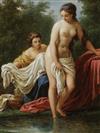
LOUIS JEAN FRANCOIS LAGRENEE (French, 1725 - 1805). Nymphs Bathing, circa 1770, Signed and dated in the lower left corner: (J?) . Lagrenée / 1770. Oil on canvas. Framed. - Sight: 17.75 x 21.5 inches Estimate $30,000-40,000
PROVENANCE Le Duc de Grammont, by 1773 until 1775; His sale, Paris, 16 January 1775, lot 76 (sold for 1145 francs); le Chevalier Lambert, until 1787; His sale, Paris, Le Brun, 27 March 1787, lot 211 (sold for 1000 francs, to Le Brun); Acquired by a private collector in the 1950s; By whom sold, New York, Sotheby's, 5 June 2014 lot 71; There acquired.
EXHIBITED Possibly Paris, L'Académie Royale, Salon, 1771, no. 10; Possibly Paris, L'Académie Royale, Salon, 1773, no. 18 (as in the collection of M. le Duc de Grammont);
LITERATURE W. Janson (ed.), Catalogues of the Paris Salon 1673 to 1881, London 1977, 1771, p. 6, cat. no. 10, 1773, p. 9, cat. no. 18; Mireur, Dictionaire des Ventes d'Art, Paris 1911, vol. IV, p. 152; Seznec, Diderot. Salons, Oxford 1957 - 1967, vol. IV, p. 131; Sandoz, Les Lagrenée: I. Louis (Jean, François) Lagrenée 1725 - 1805, Paris 1983, p. 226, cat. no. 214 (as location unknown).
ARTIST PROFILE: Louis-Jean-François Lagrenée (called Lagrenée l'aîné, Lagrenée the elder) (30 December 1724 -19 June 1805) was a French rococo painter and student of Carle van Loo. He won the Grand Prix de Rome for painting in 1749 and was elected a member of the Académie royale de peinture et de sculpture in 1755. His younger brother Jean-Jacques Lagrenée (called Lagrenée le jeune, Lagrenée the younger) was also a painter. His career blossomed in Paris, by completing many commissions for eminent patrons and members of a flourishing new financial community as well as submitting regular entries to the Paris salon exhibitions. His reputation caught the attention of Elizabeth Petrovna, Empress of Russia, who, in 1760, appointed him to the offices of the director of the Imperial Academy of Arts and that of her principal court painter.[7] After only two years in Russia, he returned to Paris to take up the appointment of professor-rector at the Royal Academy. He spent the years between 1781 and 1787 at the Villa Medici in Rome, in his capacity as director of the French Academy. A final return to Paris saw him appointed to the position of honorary curator-director (administration) of the Louvre museum. He was made a Knight of the Legion of Honour on the 15th of July 1804 by Napoleon I.[8] He died the following year.