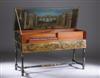
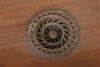
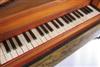
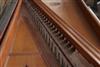
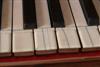
RARE AND IMPORTANT HONOFRIO GUARRACINO (NAPLES, ACTIVE 1651-1694) ITALIAN RECTANGULAR VIRGINAL,Circa 1670 with outer case first quarter of eighteenth century. Instrument's case is of cypress with finely joined dovetails; containing a single manual half-recessed keyboard, supplying a four octave C/E-c3 compass, with natural keys of beech covered with ivory slips and accidentals stained black with ebony tops. It has a decorative parchment wedding cake rose with an outer ring identical to two other Guarracino instruments, set in a spruce soundboard with single bridge and nut atop the wrestplank. Two covered storage wells left front and rear accommodate spare parts and tuning tools. The instrument is in near playing condition and has been examined by Mark Adler and J. Scott Odell in 2008.
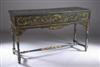
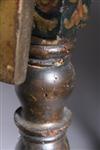
Outer case is elaborately hand-painted green with gold arabesque patterning on baluster-turned stand connected by ring-turned medial stretcher base on ball feet. The case opens to a Neapolitan Mannerist School depiction of Christ with the Woman Taken in Adultery before a classical portico and idealized town view on the underside of the lid. - 36 3/4 in. x 62 in. x 21 1/2 in. Estimate $50,000-60,000
PROVENANCE: Charles Morgan (1795-1878) industrialist and owner of Louisiana and Texas Railroad and Steamship Company and by descent to present owner.
This rare and important virginal by Honofrio Antonio Guarracino survives today as a remarkable example of Neapolitan craftsmanship and artistry. This Italian rectangular virginal is one of eleven known examples of Honofrio Guarracino''s work and identifies most closely with the virginals at Finchcocks, Kent,Great Britain (1668) and the University of Edinburgh, Scotland (1678). Additional examples of his work are found in the collections of the Royal College of Music, London (No. 175), Gemeentemuseum, the Hague (Cat. No. 1933.0543), Metropolitan Museum of Art, New York, (No. 45.41), Boston Museum of Fine Arts (Cat. No. 1986.518), and Musikinstrumentenmuseum, Berlin (Cat. No. 4650).
Part One. Outer case: Very good overall condition: The exterior hand-painted surface decoration dates to the latter part of the eighteenth century, while the turned stand probably dates to the early eighteenth century, circa 1720. The whole appears with old worm.
Part Two. Inner case: The instrument is in near playable condition. However, the playability was addressed in the twentieth century, during which time the turning pins were drilled and the instrument fitted with iron wires and a large metallic underplate. The tension of these iron wires today has pulled the bridge from the underlying soundboard in several areas. The metal plate was not removed during examination.
The original arcaded key-fronts and music rack are not present with the instrument. The name batton, lowest natural key of beech, stained accidentals, knobs to covered wells have been replaced over the years. A mechanical mark divides the F key tail horizontally and extends through the base key. The natural keys are hand-numbered in modern non-European hand. The soundboard appears with two age cracks that have finely executed old shims. The parchment wedding-cake rose exhibits minor losses.
Painting on Inside Lid Condition: Horizontal crack through lid 4 in. from top edge. Some scattered small indentations and minor flaked losses. UV: Scattered areas pf inpainting throughout, especially along left and right edges.